Journal लेख
Samjhana
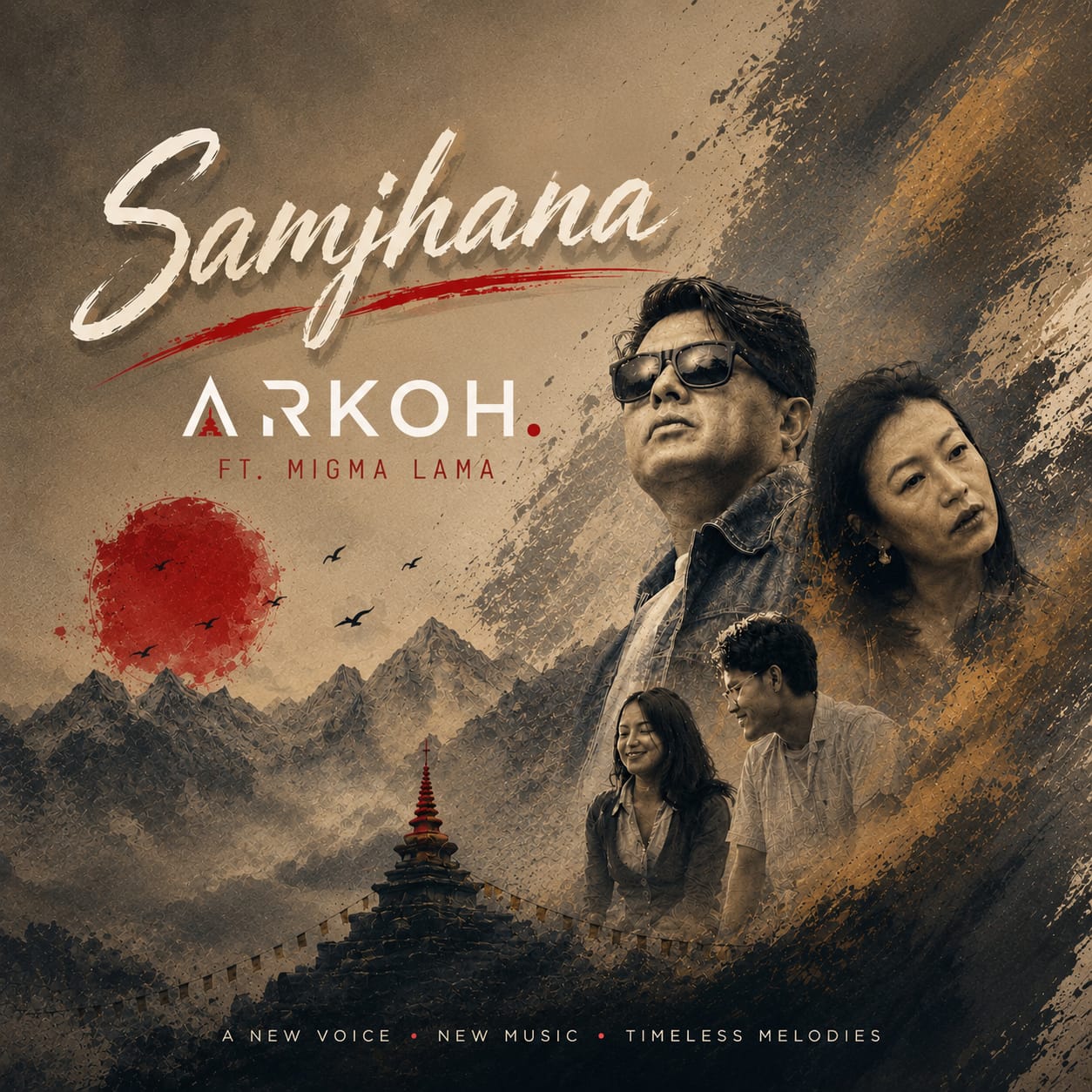
Samjhana means “memories” in Nepali, but not the kind you scroll past in your photo app. It’s about the love that never truly leaves. Life moves on, as it often insists on doing, but some memories quietly stay behind, tucked into a corner of your heart, reminding you of who you once were. Sometimes you don’t get a choice; you simply accept what life hands you, even when your heart aches. That bittersweet acceptance is what this song is about.
Fittingly, the song about memories that wouldn’t leave took two years to leave my home studio. But let me start at the beginning.
Born on the couch
One of my favorite ways to unwind is to grab my mini acoustic guitar, slouch on the couch (don’t tell my chiropractor), and noodle around until something magical, or at least mildly entertaining, happens. Some of my best tunes have come from these lazy jam sessions, and Samjhana is one of them. It started as a minor blues progression, inspired by Keb’ Mo’s Rainmaker, and in about an hour the whole song spilled out: verse, chorus, bridge – the works. Sometimes creativity just flows through you. Other times, you stare at the ceiling for a month. That day, the river was generous.
So I had a song. All I had to do was record it. How hard could it be?
Two years, give or take
Writing a song is one thing; recording it is a whole different ballgame. Think football, but with multiple goalposts, referees, keepers, and so on. It took me about two years to finish this one. (Hey, Rome wasn’t built in a day, and neither was my home studio.)
Although Samjhana was born on an acoustic guitar, I always heard it with that clean, dreamy single-coil electric shimmer, think Fender Stratocaster. But once I started recording, I discovered that simple acoustic-style strumming wasn’t cutting it. So I threw in some gentle plucking and switched up a few chords, and suddenly the song had a whole new attitude.
Enter the wizard
Then my good friend Marc-André Juillet jumped in on drums. Marc-André is one of those rare drummers who can play anything – hardcore punk, jazz, polka, you name it – and he brought serious finesse to the track. Of course, the moment I heard his drums, I immediately wanted to tweak a few things. Musicians can’t help themselves.
Making music is a team sport. No matter what you picture in your head, your collaborators are going to sprinkle their own magic all over it. It’s a lot like building software: executives dream, designers design, developers develop, QA tests, writers write, and marketing does… well, marketing things. What started as product A somehow becomes product A+B, with a mysterious new feature you never knew you needed. Samjhana got several of those features, and I’m grateful for every one.
With MA’s drums locked in, I went on a little update spree: tweaking guitar tones, swapping rhythm patterns, inventing some tasty new riffs. The bridge, in particular, got a major glow-up. Samjhana was always meant to be a duet, and I wanted the bridge to be the moment where the female vocal bursts through – a dramatic, heartfelt cry of emptiness and longing. That cry is the heart of the song, so I fussed over it until it synced perfectly with the drums.
Finding the voice
Next up: vocals and bass. I recorded my vocals in my home studio – my neighbors are now intimately familiar with my “emotional singer” voice. But honestly, the biggest reason this song took two years is that I couldn’t find the right female vocalist. A duet about longing needs two voices that genuinely ache for each other, and you can’t fake that chemistry.
Then, on a trip to India, a friend introduced me to Sangu Saishree, a film director, who in turn connected me with a rising star from Kathmandu, Nepal – Migma Lama. She sent me a phone-recorded demo that instantly blew me away. She had nailed the vibe, and our voices blended together like momo and achar. The search was over. (Sangu and I ended up teaming up on the music video too. Yes, it’s all about who you know!)
The bass had its own plot twist. I usually play bass myself, but for this song, I just couldn’t crack it. Enter Dev Lama, a local musician Migma recommended. Dev is actually a guitarist by trade, but he laid down bass lines so smooth you’d think he was born with a bass in his hands. Sometimes you just have to let the pros take over.
The final mix
With all the tracks recorded, it was time to mix. Marc-André, already a killer drummer, has been moonlighting as a music production student, and he offered to mix the song. I couldn’t say yes fast enough. Giving feedback on mixes can be tricky (it’s a bit like telling your friend their haircut is… interesting), but he understood exactly what I was after. After a few rounds of back-and-forth Samjhana was ready to face the world.
The part that still amazes me: MA doesn’t understand a single word of Nepali, yet he captured the feel of the song perfectly. Which, when you think about it, is the whole point of Samjhana – some things don’t need translation. Longing sounds the same in every language.
Memories, delivered
So, after all this beautiful chaos and collaboration, we ended up with something even more beautiful than what I hummed on my couch that afternoon: heartfelt male and female vocals, melodic guitar lines, and lush keys – a Western rock and pop blended with the soul of Nepali music, carrying the bittersweet weight of love, life, and the memories we all quietly carry within us.
The music video is coming soon, and I’ll spill more behind-the-scenes secrets then. In the meantime, check out Samjhana on Spotify (or whatever platform you fancy) – and hey, maybe hit subscribe so I can keep making songs instead of taking up knitting.
Also on Apple Music.
P.S. No AI tools were used to create this music. Everything was recorded, mixed, and mastered using traditional analog and digital gadgets, at home and in the studio. The memories, too, are 100% organic.